Sunday, August 1, 2010
Google search tricks
Sunday, July 25, 2010
Copyright state of mind
The books, Wealth of Networks, Remix, and Digital Copyright, explain how our current copyright law is an environment of prohibition, that is, assume everything is copyrighted unless otherwise told it is not. This is an unreasonable way to function in the digital age, where information sharing of any stripe is second-nature.
The books really changed the way I think about what I see on the mass media and what is available in the public domain. If we want a culture of possibilities, of work that is created by the public for social advancement, we need less private owners. Passive consumption is not enough.
Monday, July 19, 2010
File under #matteroftime
E-Books Now Top Hardcovers at Amazon
Excerpt
Amazon.com, one of the nation’s largest booksellers, announced Monday that for the last three months, sales of books for its e-reader, the Kindle, outnumbered sales of hardcover books.
In that time, Amazon said, it sold 143 Kindle books for every 100 hardcover books, including hardcovers for which there is no Kindle edition.
The pace of change is quickening, too, Amazon said. In the last four weeks sales rose to 180 digital books for every 100 hardcover copies. Amazon has 630,000 Kindle books, a small fraction of the millions of books sold on the site.
Thursday, July 15, 2010
I'm warming up to algorithms
But algorithms, which I was told by a computer science graduate from a top science school, are simply recipes or instructions for figuring out a "problem."
Algorithms are being explored for lowering newsroom costs (this is the savior part). Duke University is working on applying algorithms to computational journalism that could find anomalies or discrepancies in, say, a stack of public documents.
But most famously, algorithms are a huge part of search engine results. This has had an enormous impact on our ability to find stuff on the Internet.
As librarians, we should be thinking about the role of algorithms in future library settings, especially digital, if we want to remain competitive and useful to patrons. As the Wikipedia entry on "search algorithm" states for "Explicity stored databases":
Algorithms for searching in explicitly stored databases include the simple linear search, and many other algorithms that use a variety of search data structures, such as binary search trees, heaps and hash tables, to speed up multiple queries over the same database.
There are also many algorithms designed specifically for retrieval in very large databases, such as bank account records, electronic documents, product catalogs, fingerprint and image databases, and so on.
If librarians are going to use or build databases to find information for patrons, we should consider how algorithms work and how to make them most effective.
time management skillz needed
My occupations right now are a media policy fellowship, graduate school (MLIS program) and serving on the board of directors for a nonprofit organization. All of which require a combination of reading, research, writing, travel, networking and a lot of e-mailing.
So in that spirit, here are some time management tips from the Mayo Clinic, abridged:
- Plan each day.
- Prioritize your tasks.
- Say no to nonessential tasks.
- Delegate.
- Take the time you need to do a quality job.
- Break large, time-consuming tasks into smaller tasks.
- Practice the 10-minute rule.
- Evaluate how you're spending your time.
- Limit distractions.
- Get plenty of sleep, have a healthy diet and exercise regularly.
- Take a time management course.
- Take a break when needed.
Sunday, July 11, 2010
Pitt MLIS first visit
The MLIS Cohort 10 met in person for the first time on Friday and Saturday at the University of Pittsburgh campus. This was quite a treat -- it brought everything home. The experience really did connect our virtual learning environment with the traditional, physical learning structure, and being on campus made me feel part of the campus.
Here is a picture, taken from Google Images, of the Information School building on Bellefield Avenue. The poured concrete building has architectural flaws, in both design and function, but that's okay. It was built in 1962, we were told, and is in the Brutalist style.
The other part about being a Pitt student is the education is in Pittsburgh, probably one of my favorite US cities. I was introduced to Pittsburgh last year when I went there to attend a wedding, and I was impressed with the city. Cool vibe, energy, pace, and people. I was happy to return this year and I liked it even more. I went to the highest floor in the Cathedral of Learning (36th?), and walked around campus.
Here is a shot of the Oakland neighborhood, where the Pitt campus is, in P-Town.
Thursday, July 1, 2010
Copycat bills of AZ SB 1070 in other parts of US
View States and politicians considering bills similar to SB 1070 in a larger map
Tuesday, June 29, 2010
When libraries needed space
"There is little room for modern technology..."
Libraries of the future: "urban information bar"
Monday, June 21, 2010
File under #inevitable: price of e-readers cut
Barnes & Noble, the national bookseller, announced Monday that it was dropping the price of its six-month-old Nook e-reader to $199 from $259 and introducing a new version of the device, which connects to the Internet only over Wi-Fi networks, for $149.
Responding rapidly, Amazon.com then cut the price of its popular Kindle e-reader below the Nook, to $189 from $259.
The companies are competing with Apple's iPad. The move signals another shift toward an all-digital world replete with increasingly affordable platforms that will enable us to easily access news and information.
For library professionals, this also means funds may have to be spent on purchasing these to loan to patrons or to use on site. These Internet-ready devices, which have surface dimensions the size of your average book, could clear not only book shelving space but clunky computer space, too.
Wednesday, June 16, 2010
YouTube and Guggenheim partner for cultural populism
Nancy Spector, chief curator of the Guggenheim Foundation, calls the collaboration an opportunity to see how new technology platforms might change the video art form. "We are, in a sense, inviting people to raise the standards" of YouTube, she says. "This is aspirational for people who are interested in seeing their work be taken artistically."YouTube brought musicians together from around the world last year in the first collaborative orchestra and the arts project runs along the same mission: Discover talent where you normally would not find it and make art where you normally would not. This project signals a positive trend in building relationships on the Web and pushing the boundaries of artistic inclusion.
Monday, June 14, 2010
What happened to my followers?
Sunday, June 13, 2010
Are humans necessary for info "serendipity"
And third — deepest down — the coherence of newspapers is not intellectual, it’s industrial. Which is to say, if you’re running a website and somebody’s on your website and they just done a crossword puzzle and they seem to really like it, what’s the next thing you’re gonna show them? Is it news from Tegucigalpa? No. It’s another crossword puzzle, because that’s the only thing you can [inaudible]. The idea that someone who is doing a crossword puzzle may also want news about the coup in Honduras or how the Lakers are doing — it doesn’t make any sense. It’s never made any sense, in terms of what the user wants. It’s what — it’s what print is capable of as a bundle. What goes into a print newspaper is the content that, on the margins, produces commercial interest in the least interested user. So, in the language of my tribe, the aggregation of news sources has gone from being a server-side to a client-side operation — which is to say, the decision about what to bring together into a bundle is made by the consumer and not at the level — and not by the producer.
Tuesday, June 8, 2010
Geotagging New York tourist areas
Gawker.com posted the above image, "This Map Shows You How to Avoid Tourists in New York," that was created by geotagging photos collected on Flickr. The photos were sorted by ones posted by locals and ones posted by tourists, then the data was coded for a color key (blue for locals, red for tourists).
The result is a striking visual of Manhattan from above that suggests all kinds of information: Where to avoid crowds, where the action is, what part of the city is most visited.
This project is a great example of presenting information easily available online. How can librarians use Flickr to tell a story about local information. What kind of information can be presented in the library setting using geotagging and Flickr or some other vast socially networked database?
Monday, June 7, 2010
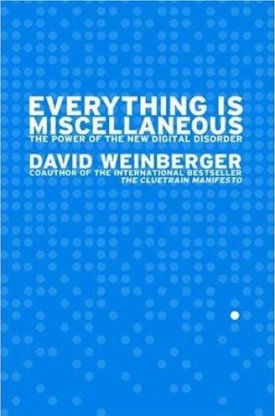
Everything is Miscellaneous
Dr. Weinberger, who is a fellow at the Berkman Center for Internet & Society, argues that finding and sharing information in the digitally networked age is subject to the whims of the individual thinker and in order for us to make sense of the information before us, we need to get out of the way. That is, remove the historical linguistic constructs that lead us to information sets because arbitrary navigational cues could negatively affect the integrity of our search.
Look sideways and create your own criteria for what you need.
Saturday, June 5, 2010
The FTC and journalism
The context of course is the the massive contraction in the market-based news industry over the last several years (2008 and 2009 were especially brutal), where thousands of news jobs were eliminated and papers closed their business or shrank the physical size of the newspaper.
The FTC, and FCC, convened a series of workshops on the matter and invited stakeholders from around the country to discuss where to go from here. The FTC will meet June 15 to review what they have heard up to now and have released a draft of policy proposals.
Among concepts: What changes, if any, should be considered for copyright and Fair Use; an examination of government subsidies, proposals for increased public funding, legal changes to encourage new news organizations, hybrid corporations, and innovations lowering the cost of journalism.
Some of the potential changes to media law could affect library science as copyright and fair use doctrine will be re-examined. Also, if some of these proposals become law, they could shape how information users find material, and how would that affect the modern library?
We are in an age of constant news and information creation, from millions of individuals. We are well networked and our tendency now is to share what he have and seek what we want on our own.
Monday, May 31, 2010
Tweets eclipsing some print newspapers?
I was at a fellows retreat in May and an interesting factoid was presented to the group during a bar-style trivia game.
We were asked: What is larger? The average number of Tweets posted in one hour or the daily circulation (M-F) of The Washington Post and The New York Times combined?
Your guess might depend on your age. The answer, if you follow the links above, is Twitter. The livestreaming social networking tool clocks about 1.8 million Tweets per hour while 1.53 million print copies of the two major metro newspapers are circulated daily.
What does that kind of number tell us about our news and information dissemination habits? I would guess a lot of our Tweeting includes information found in those newspapers.
What do you Tweet and how often?
According to this funny graphic of the Social Media Mullet, Twitter is all party in the back while LinkedIn is business in the front. However this is not the case for me. First, I never check my LinkedIn account, but I rely on Twitter for business and new-journalism networking (I am a former newspaper reporter and I am a media policy fellow studying ideas about the future of news). And I find Twitter connects me to well vetted information supplied by the people I follow. You could say Twitter "circulation" has replaced traditional newspaper circulation today.
Tuesday, May 25, 2010
New Yorker magazine to offer tablet platform editions, set pricing
One of my favorite magazines, The New Yorker -- the culture weekly that piles up quickly but is still fresh months, even years later -- will be available on digital tablet technology as well as in print, and Editor David Remnick is holding steady on pricing and content, according to an Advertising Age article published online today:
Mr. Remnick also said The New Yorker won't bow to any dictates over its content from Apple, which has been blocking iPad and iPhone apps that it deems too racy. "We're going to publish what we're going to publish," Mr. Remnick said. "If the Pentagon isn't going to talk me out of a story, then Apple in Cupertino isn't going to either. If they throw me off, they throw me off."Mr. Remnick should be uncompromising on content, but he may want to reconsider charging customers of the print edition ($5.99 single copy, $39.95 for one year subscription) for digital access. According to the article, The New Yorker Kindle edition is $2.99 per week, and an iPad application may cost the same as the single copy print edition.
How will reader behavior be shaped by this? If I traveled a lot and wanted the convenience of a digital reader, would I abandon my print subscription altogether? How much do I really value having the paper product in my hand --enough to pay double for the product in two versions?
And will this pricing structure create a sustainable publishing model?
Friday, May 21, 2010
Pennsylvania to look at updating library systems
This is exciting -- and necessary. This will give librarians a chance to implement new directions in library services and information sharing and will help libraries remain relevant to users of community anchor institutions.
From the article, headlined "Study of library issues sought":
A study is needed because the state library code dates back to 1961, well before the advent of personal computers and electronic communication, Mr. Pileggi said Thursday. The study should be far-reaching enough to address issues beyond the state's fiscal crisis, he added.
"The state subsidy issue will remain as long as we are in a recession," Mr. Pileggi said. "At some point, we will be out of the recession. We need a fresh look at what is the best way to organize libraries."
Tuesday, May 18, 2010
Distance learning
I've never taken a class online, much less a whole degree. The MLIS material is fascinating to me -- I am excited about the school's approach (that library science is fundamentally a communication science) and I like the book lists so far (Yochai Benkler!). Based on the first lecture in LIS 2000, this program seems thoroughly post-modern. There is some re-imagining going on here of what is a library and what is information today.
However, one observation, and I'm sure I will adapt to the virtual classroom interface, but one drawback from virtual orientations is that there is quite a bit of frustration and time taken to understand the online system. We are using Blackboard and some of it is unintuitive, making navigation frustrating. For instance, I have to go through what feels like 25 clicks to find everything I need: assignments, discussion boards, reading lists, lecture videos, etc. And times this by two, since I am taking two classes this term. There should be a master page that simply says: HERE IS WHAT YOU ARE TO DO THIS WEEK and have on there reading assignments, writing assignments, links to the reading and writing assignments where necessary, links to that week's lecture, required discussion posts with a link to the thread, necessary software with links to the downloads, announcements, etc. All those items can be found on Blackboard, but they are in about 10 different places.
The interface will take familiarization, and I'm sure it won't take long. But starting out in a virtual classroom has been tricky.